


Managing IT internally has grown increasingly complex. Businesses face rising operational costs, evolving cybersecurity threats, and constant technology updates.
Cost pressure still rules IT decisions, with 92% of companies chasing savings and 37% reworking vendor contracts to spend less.These pressures make it harder to maintain performance while scaling operations.
The benefits of IT outsourcing directly address these challenges by giving organizations access to specialized skills, advanced tools, and flexible services. Outsourcing also allows internal teams to focus on strategic business goals rather than firefighting daily IT issues.
|
As Paul Marchese, CEO of MCP, says, “Outsourcing IT allows businesses to stay agile, reduce costs, and access expertise without overburdening internal teams.” |
In practice, the advantages of IT outsourcing often reveal themselves through:
-
Cost efficiency by shifting from fixed overhead to predictable, scalable expenses.
-
Access to expert talent across cybersecurity, cloud, and network management.
-
Enhanced security with proactive monitoring and compliance support.
-
Scalability and flexibility to adapt quickly to market changes or growth demands.
-
Strategic focus that empowers internal teams to drive innovation and customer value.
Despite these advantages, IT outsourcing is not without risks. Businesses must balance the pros and cons carefully to maximize value while mitigating operational and security challenges. This blog explores the key benefits of outsourcing IT services, the practical risks involved, and strategies for safe, effective adoption.
Top Advantages of Outsourcing IT Services That Reduce Costs and Boost Productivity
Outsourcing IT is one of the most effective ways to manage costs while improving efficiency. Many businesses struggle with the expense of full‑time IT teams, licenses, hardware, and ongoing training. By partnering with a qualified provider, you only pay for the services you actually need, reducing overhead and enabling predictable budgeting.
Operational efficiency is another major benefit. Routine maintenance, monitoring, and updates can be handled externally, freeing your staff to focus on product development, customer engagement, and other high‑value tasks.
Scalability and flexibility also stand out. Whether you’re launching a new project, expanding offices, or facing seasonal spikes, outsourced IT services can scale seamlessly. You avoid the delays and costs of hiring or training additional staff, while services adjust to your business size and demands.
Taken together, the advantages of outsourcing IT services often show up in clear, measurable ways:
-
Cost reduction through predictable expenses and the elimination of hidden overhead.
-
Operational efficiency by offloading routine maintenance and monitoring.
-
Scalability and flexibility to adapt quickly to growth or seasonal demand.
-
Productivity gains as internal teams focus on innovation and customer value.
-
Long‑term savings supported by optimized tools and streamlined workflows.
The financial impact is significant. According to Deloitte, 59% of businesses rely on IT outsourcing as a cost‑saving strategy. By reducing internal staffing, optimizing tools, and improving workflow efficiency, outsourcing delivers measurable productivity improvements and sustainable growth.
Don’t Let IT Drag Your Business Down!
Outsource strategically to reduce downtime, improve security, and streamline operations.
Benefits of Outsourcing IT Services That Improve Security and Compliance
Security remains one of the most critical benefits of outsourcing IT services. Outsourced teams bring expertise in cybersecurity, monitoring, and threat detection, implementing multi‑factor authentication, intrusion detection, and malware protection to keep systems secure.
Compliance is another major advantage. External providers help you adhere to standards such as CMMC, GDPR for data privacy, HIPAA for healthcare, and PCI DSS for payments, reducing the risk of legal penalties while ensuring business continuity.
Disaster recovery and business continuity are also built into most outsourcing agreements, with automated backups, failover systems, and emergency response plans keeping data safe and accessible even during outages.
When businesses outsource IT for security and compliance, the benefits typically include:
-
Enterprise‑grade protection with firewalls, encryption, and intrusion detection.
-
Audit‑ready compliance support across GDPR, HIPAA, PCI DSS, and industry regulations.
-
Disaster recovery planning with automated backups and rapid restoration.
-
Proactive monitoring that reduces downtime and resolves issues quickly.
These advantages are critical to protecting your business and building customer trust while leveraging modern IT solutions.
Exploring IT Outsourcing Advantages for Strategic Growth
Beyond security, outsourcing IT can also support strategic business growth. With access to specialized expertise, companies can implement new technologies faster, whether cloud migration, AI integration, or advanced network monitoring.
Internal teams remain focused on core business functions while external experts manage complex technical operations. This separation allows organizations to innovate without overextending staff resources. Speed of technology adoption is a key advantage, as providers maintain updated knowledge of tools and platforms, ensuring seamless integration of new solutions.
Strategic growth through outsourcing often looks like:
-
Faster technology adoption with expert guidance on cloud, AI, and emerging platforms.
-
Innovation without resource strain as internal teams focus on customer and product priorities.
-
Scalable support that adapts to expansion, acquisitions, or market shifts.
-
Risk reduction through clear SLAs, defined responsibilities, and transparent communication.
Read More!
Key IT Outsourcing Pros and Cons Every Business Must Consider
While the benefits of IT outsourcing are significant, businesses must weigh them against potential risks. Loss of direct control is a common challenge—outsourcing shifts some operational decision-making to your provider, which can slow response times if expectations are unclear. Vendor dependence is another risk, as relying heavily on a single provider can be dangerous if they face staff shortages, financial difficulties, or service disruptions.
The most common risks businesses should keep in mind include:
-
Loss of direct control if responsibilities are not clearly defined.
-
Vendor dependence that creates vulnerability if a provider struggles.
-
Hidden costs from integrations, support, or unexpected services.
-
Communication challenges across locations or time zones.
Mitigating these risks requires diversification, contingency planning, and clear reporting standards to maintain alignment and prevent missteps.
IT Outsourcing Advantages and Disadvantages in Data Security
Global spending on data security has climbed to $81.6 billion. Security remains a top concern in outsourcing. Sharing sensitive information increases exposure if proper controls are not enforced. Strong SLAs, identity management, and monitoring are critical to prevent breaches. Compliance failures can also lead to legal and financial risks, making audit readiness essential.
When it comes to data security, outsourcing can deliver both strengths and challenges:
-
Enhanced monitoring and identity management reduce breach risks.
-
Audit‑ready compliance support ensures adherence to GDPR, HIPAA, PCI DSS, and other standards.
-
Exposure risks if providers lack proper controls or governance.
-
Legal and financial penalties if compliance is not maintained.
Properly managed outsourcing reduces exposure while maintaining operational integrity, but businesses must ensure providers follow industry regulations consistently.
Navigating the Potential Impact of IT Outsourcing on Internal Teams
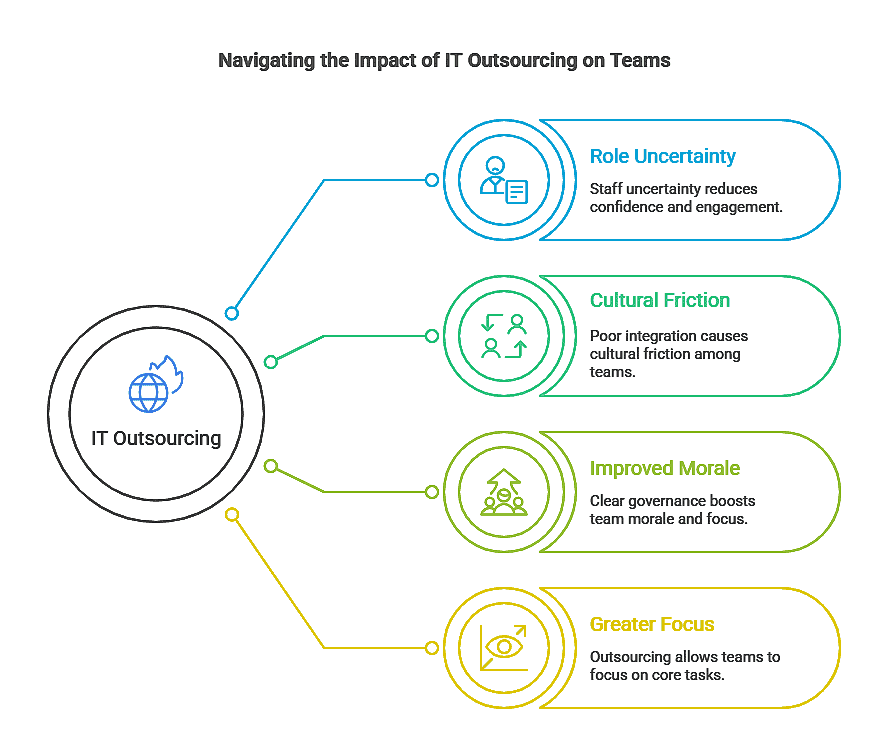
Outsourcing IT inevitably affects internal teams. Staff may feel uncertainty about their roles or influence on technical operations. Without clear communication, morale can suffer.
The impact on teams often shows up in these ways:
-
Role uncertainty leading to reduced confidence or engagement.
-
Cultural friction if outsourced services are poorly integrated.
-
Improved morale when governance and shared responsibilities are clearly defined.
-
Greater focus on strategic projects once routine IT is offloaded.
By establishing shared responsibilities and reporting structures, businesses can integrate outsourced services without disrupting internal culture. A well‑managed partnership ensures smooth collaboration and alignment with business goals.
Select the Right Partner for Optimal Benefits of IT Outsourcing
John-David Lovelock, Distinguished VP Analyst at Gartner, notes that IT services firms will account for over 70% of technology spending in 2025. Choosing the right provider maximizes the benefits of outsourcing while minimizing risks. Poor vendor selection, hidden fees, or weak communication can derail operations and sink revenue.
Qualities to prioritize when selecting a provider include:
-
Certifications and technical skills that prove expertise.
-
Proven experience supported by case studies and testimonials.
-
Clear SLAs and KPIs to ensure accountability and service quality.
-
Alignment with business objectives for long‑term strategic value.
A strong partner should handle transitions smoothly, support pilot programs, and provide measurable outcomes. Selecting wisely ensures seamless integration of outsourced systems and minimizes disruptions during the transition.
Governance and Performance Tracking for Outsourcing IT Services
Governance is the backbone of successful outsourcing. It ensures consistent results by keeping providers accountable and operations transparent. Regular reviews of uptime, response time, and issue resolution help maintain service quality, while diversifying critical functions prevents over‑reliance on a single vendor.
Strong governance practices often include:
-
Regular KPI reviews to track uptime, response times, and resolution speed.
-
Diversification of vendors to reduce dependency risks.
-
Clear communication protocols that define escalation paths and reporting schedules.
-
Structured oversight that balances provider autonomy with business control.
These measures improve performance and keep you informed about operations while retaining oversight.
Aligning Outsourcing with Business Objectives for Sustainable Benefits
Outsourcing delivers the most value when aligned with business goals. Mapping the scope of work to strategic priorities ensures IT supports growth and efficiency rather than becoming a siloed function.
To align outsourcing with long‑term success, businesses should:
-
Map IT services to strategic priorities like innovation, efficiency, and customer experience.
-
Plan for scalability so infrastructure adapts as the business evolves.
-
Incorporate disaster recovery, security, and compliance into contracts to minimize risks.
-
Use structured governance models to ensure IT outsourcing supports sustainable growth.
This structured approach ensures outsourcing is not just tactical but a driver of long‑term success.
How IT Outsourcing Advantages Vary by Industry
Different industries experience IT outsourcing benefits and risks in unique ways. Sector‑specific demands shape how outsourcing is applied:
Industry‑specific dynamics include:
-
Healthcare: strict patient data security and compliance make outsourcing valuable for monitoring systems and supporting clinical workflows.
-
Financial Services: high regulatory requirements and uptime demands require skilled outsourced support to maintain secure infrastructure.
-
Construction and Energy: mobility and reliable communication across sites benefit from outsourced IT services that ensure uninterrupted operations.
Real‑world examples show outsourced IT improves system stability, reduces downtime, and enables organizations to focus on core business goals.
Important Factors to Consider When Outsourcing IT
Outsourcing IT provides many benefits, but some factors are often overlooked. Addressing these areas can significantly enhance efficiency, security, and operational control:
|
Service Area |
Key Advantage |
Impact on Business |
|
IT Policy Development |
Standardized IT policies |
Ensures consistent decision‑making and compliance |
|
Vendor Management |
Centralized oversight of third‑party tools |
Reduces risk of misaligned services and performance gaps |
|
Legacy System Support |
Experienced handling of older systems |
Minimizes downtime and ensures continuity during upgrades |
|
IT Cost Analysis |
Transparent reporting of IT spending |
Allows better budget planning and cost efficiency |
|
Performance Benchmarking |
Ongoing metrics tracking |
Improves accountability and strategic IT decisions |
This table highlights critical areas that may not be fully covered in daily operations but significantly enhance the value of IT outsourcing.
Harness the Benefits of IT Outsourcing for Your Business with MCP
Outsourcing IT offers major advantages in cost savings, scalability, and security, but risks arise when the wrong partner is chosen. Success comes from partnering with a managed services provider that delivers measurable results and aligns with your business goals.
MCP provides tailored IT outsourcing solutions that enhance efficiency, protect data, and scale with your growth. With 43+ years in business, 0 managed services clients ever compromised by data breaches, and a 5-minute response time for critical requests, we ensure your IT operations remain secure and reliable.
Partnering with MCP means:
-
Predictable IT costs that reduce overhead and improve budgeting
-
Advanced security and compliance support that protects your data
-
Scalable systems that adapt as your business grows
-
Proven results across 200+ companies and 1,000 endpoints concurrently managed
Schedule a Consultation
Discover how MCP can help your business reduce costs, secure critical data, and scale confidently.